
3d Design For Kids
This post may contain affiliate links.
There are so many uses for 3D printing in today's world, and now kids can get in on the action, too! Here is how Your Kids Can Design and Print in 3D!
When it comes to kids coding activities, there are a lot of options for screen-based activities. Finding a good balance between unplugged coding activities and screen-based activities is always a goal of mine.
3D printing has become a big deal in the last few years, and can help reinforce some of the concepts coding games are helping kids learn. The process is fairly simple; design, slice, print. But when it comes to the execution, you can teach or reinforce all sorts of coding concepts.
Read on to learn the specifics about how Your Kids Can Design and Print in 3D!
3D Design For Kids!

For the design process, you will need some kind of 3D design creation software. These are sometimes called C.A.D., or "Computer-Aided Design". For kids learning to design, you don't need the top-of-the-line software. All the "extras" will just confuse your child. To help your child begin to design in 3D, first take a look at Thingiverse.
Thingiverse is an online library of sorts, but instead of books, you can download 3D designs. When kids start to look at designing in 3D, having an idea of what the model will look like is helpful. They can find pretty much anything they want on Thingiverse, so whatever they are interested in, you will probably be able to find a model of it.
Once you have an idea of what a 3D model looks like, you will need to learn how to move and design in a 3D space. It's not quite as easy as designing in 2D or just drawing on a piece of paper. I usually head to TinkerCad to get kids started.
TinkerCad is awesome for helping kids learn to design in 3D. Once they get signed in, the "Starter" lessons teach them how to move, place, edit, and delete objects within the 3D world. After they get through the starter lessons, there is a bank of other, gradually harder lessons they can start on. If you want to get really fancy, you can have your child download one of the designs on Thingiverse, then drop it into TinkerCad so they can edit it and make it their own. Whatever they do, they will be working on visual-spacial skills and computational thinking, which are both wonderful skills to help develop a budding computer coder/programmer!
Slice (Adult Assistance Needed)
In order for a 3D design to be built, it has to be sliced into layers that the printer can understand. Each type of printer has it's own proprietary slicing software, so make sure you get the correct software for whichever printer you will be using.
When you are done helping your kid design in 3D, you will export the print to a file. The best option is usually to export as a .stl file, the most common file type for 3D design. You will then open that .stl file in the software that works for your particular type of printer.
What you will see from there depends on the printer and its software, but most of them have similar features. You will probably be asked to run some kind of repair check – where the software looks for possible printing issues and repairs the model for you to take care of them. You may be asked if you want to add a "raft" to the bottom of the model, making it easier to remove. You may also have the ability to scale up or down depending on the software, And then you will probably have some sort of "Slice" or "Print" button.
Once you click on the "Slice" or "Print" option, one of two things will happen. If the printer is hooked directly to the computer, you might hear it begin to hum and warm up. If not, you might be asked where you would like to save the new file. This should no longer be a .stl file. It will now have a new file extension, which will probably reflect the type of printer you are using. A flash drive (Thumb drive/USB stick) will be helpful here to get the file from the computer to the printer.
3D Printing for Kids (Adult Assistance Needed)

However you get the file to the printer, you will now be able to select and print it. A 3D printer works very much like a robotic hot glue gun. The printer can move side-to-side, forward and back, and up and down. The model has been sliced into layers, so the only time the printer moves up is when it has completed a layer and is moving to the next one.
I like to teach my kids about 3D printing with a deck of cards. I hand them one
The next thing we do is stack the cards back up. As we go one-by-one, I teach my kids that this is how a 3D printer works; there are many layers that make up their model, and the printer simply stacks layer after layer to eventually create their design!
For adults, you should know that the printer nozzle gets quite hot. Once the printer is printing, you should encourage your child to watch, NOT touch. Many 3D printers in schools are enclosed in some kind of box or case, to make sure that no little fingers get hurt.
Where to find a 3D printer
There are now so many 3D printers on the market, and there are quite a few affordable 3D printer options. You also might try contacting your school librarian – They may be able to tell you where in the community you can find a public-use printer. If you can't find anything
If 3D printing is something you never considered for your kids, you should start thinking about it!
The Best 3D Printers for Kids
Bestseller No. 1

NantFun DIY 3D Printer for Kids, Mini 3D Printer for Beginners, Upgraded Extruder Technology Small 3D Printer...*
- [EASY TO USE] - The mini 3D printer is super easy to use, children and beginners are able to grasp it quickly. The accuracy is as low as 0.1 mm, which allows a smooth and alive printing effect. It's an excellent tool for kids to develop interest and improve spatial imagination. Note: This mini 3D printer does not have the function of resume printing, it will print from the beginning when there is a power failure.
- [Quick assembly] - The mini 3D printer diy kit consists of 2 main parts. Usually it can be assembled in just 5 minutes according to the assembly video (included with TF card and product page). It is easy to use even for children. You can print the attached model or your own design. Note: The filament holder can point inwards or outwards, which does not affect the use.
- [FAST HEATING & SAFE] - The 3d printer is equipped with the latest extruder technology, which rarely causes problems such as nozzle clogging and poor extrusion. The nozzle is a professional all-metal nozzle, the size is 0.4mm, it reaches the operating temperature(180℃) in 3 minutes. The motors and nozzle are well protected to prevent you from burning.
Bestseller No. 2
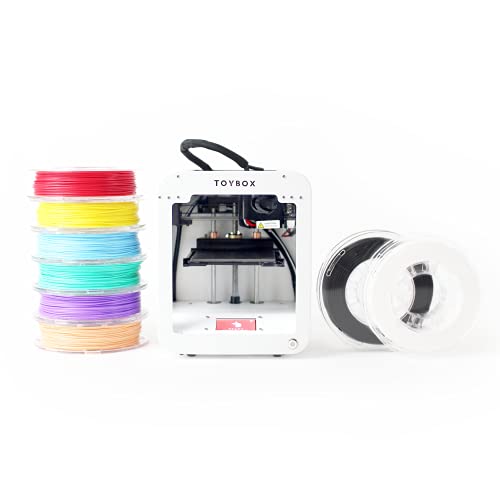
Toybox 3D Printer for Kids, No Software Needed (Includes: 3D Printer, 8 Preselected Printer Food Rolls, Free...*
- KID FRIENDLY: Built to be used by children, Toybox can be controlled with simple one-touch functions. No adult assistance needed, no need to adjust removable print bed, easy filament loading and novel print bed design that doesn't require a knife to remove prints like most 3D printers
- UNLIMITED CATALOG OF TOYS: Thousands of awesome toys are available at your fingertips in our Toybox catalog. New toys added weekly and seasonally.
- CREATOR SPACE AND EASY IMPORT: Upload designs to create your own toys or draw them and bring them to life through our user-friendly apps and tools. Your creations are stored on the cloud for easy access.
Frequently Asked Questions About 3D Printers for Kids
What age is appropriate for 3D printing?
We recommend 3D printing for kids 8 and older. There are a variety of options of 3D printers perfect for this age group.
Is 3D printing good for kids?
Of course! 3D printing teaches kids about problem solving, spatial skills and critical thinking.
How much does a 3D printer cost?
3D printers can range from a few hundred dollars to a few thousand dollars. We have a range of affordable options reviewed above.
What can kids make with a 3D printer?
Check out Thingiverse to see all the great designs you can create with your 3D printer. From figurines to practical home accessories, the sky is the limit!
Pin for later!


Katie is mom of two rambunctious boys and a self-proclaimed super nerd. With a background in neuroscience, she is passionate about sharing her love of all things STEM with her kids. She loves to find creative ways to teach kids computer science and geek out about coding and math. You can find her blogging at Teach Your Kids Code.
Source: https://teachyourkidscode.com/3d-printing-for-kids/

0 komentar:
Posting Komentar